A training robot can repeat the same task hundreds of times without changing the lesson plan. That makes it useful for teaching motion, safety, and fault finding when access to real equipment is limited.
Quick read
- A robot can repeat a task at the same speed and position.
- Sensors can show force, distance, joint angle, and error timing.
- The lesson still needs a person, a clear goal, and safe limits.
The robot becomes a repeatable workmate
Hands-on training often depends on access to one machine, one lab, or one skilled instructor. The arm can give each trainee the same starting position, task sequence, and failure case, so practice does not depend on who gets there first.
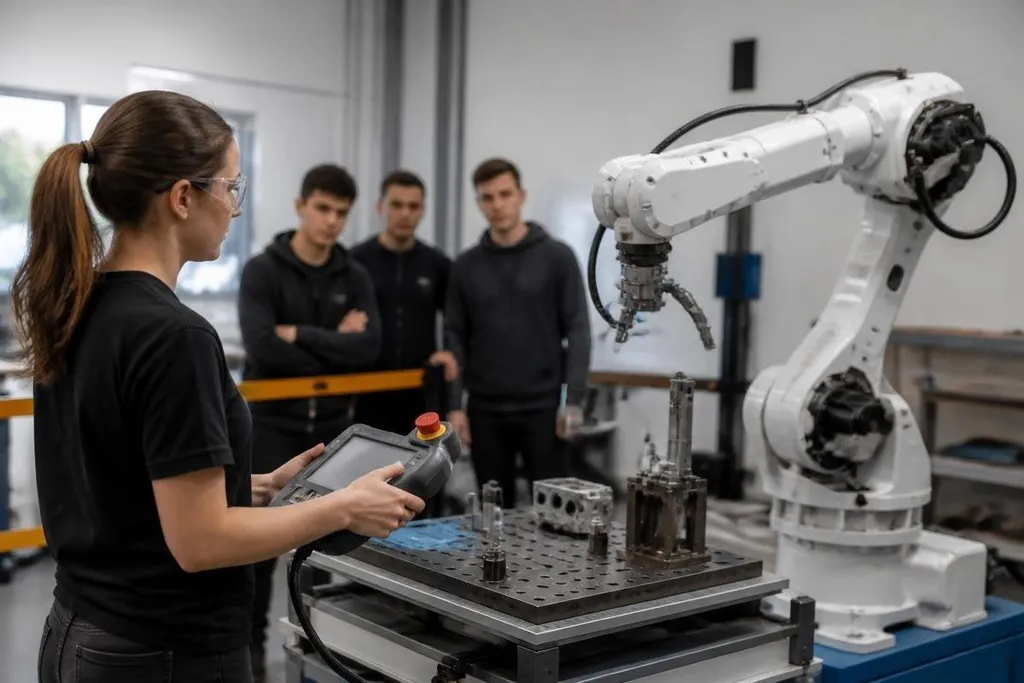
A six-axis arm can move through several joints to copy a basic industrial motion. Add a gripper, a workbench, and a simple control screen, and the trainee can practise picking, placing, fastening, or inspection tasks without using a production line.
Repeatability matters because the lesson becomes easier to compare. If five trainees run the same movement, an instructor can look at cycle time, missed positions, collision warnings, and the number of manual corrections.
That record also changes the instructor's job. They spend less time resetting the station and more time explaining why a motion failed, how a force limit works, or when a person should stop the robot.
Sensors turn mistakes into lessons
The station can show more than whether a task worked. A joint encoder measures position, a force sensor measures contact, and a camera can check whether an object sits in the right place.
Those signals give training software a way to show the moment an error began. A trainee may see that the gripper closed too early, the arm pushed with too much force, or the object moved outside its allowed area.
The same setup can teach programming. One lesson might ask a trainee to change a waypoint, which is a stored robot position. Another can require a new speed limit or a different gripper command, then show how that change affects the next cycle.
The screen should explain the result in plain terms. A red warning that says “fault” teaches little; a message that says “force limit reached during contact” gives the trainee a place to start.
Training needs real limits
A robot station cannot copy every condition on a factory floor. It may have a clean work area, fixed lighting, and objects that arrive in the same position. People still need practice with worn tools, blocked paths, changing parts, and uncertain handoffs.
Safety needs the same care. The station should use a physical emergency stop, a low speed during setup, a defined work zone, and limits that stop motion when contact exceeds the lesson's safe range.
The robot also needs a clear role. If it performs every step while the trainee watches, the lesson becomes a video with motors. The person should set up the task, change a parameter, inspect the result, and fix the cause of failure.
I'd use a robot first for repeatable tasks where errors can be measured and reset without risk.
A training drill needs a task, a measure, and a safe reset before anyone powers up the robot. Robot24 can give instructors dated examples of robots at work, so they can tie classroom practice to real tasks and set up the first session with a clear test.
A practical setup guide
Use this checklist before buying or building a training station:
- Name the task: Choose one job with a clear start, finish, and pass condition.
- Set the limits: Write down speed, force, reach, payload, and stop rules before the first session.
- Plan the errors: Add faults a trainee can see, repeat, and fix without damaging equipment.
- Record useful signals: Save cycle time, position error, force, and operator changes when they support the lesson.
- Keep a human step: Require the trainee to inspect, adjust, or approve the next cycle.
- Test the transfer: Check the skill on a different object, tool, or work position before calling the lesson complete.
The open question
The value of robot training will depend on what happens after the session. A trainee who can correct a programmed path has learned something useful, but the stronger test is whether they can spot the same problem on unfamiliar equipment.
That is where training teams should focus next: small robot stations with clear measurements, safe failure cases, and a direct link to the machines people will actually run.